
How to Maintain Your Concrete Driveway in South Carolina
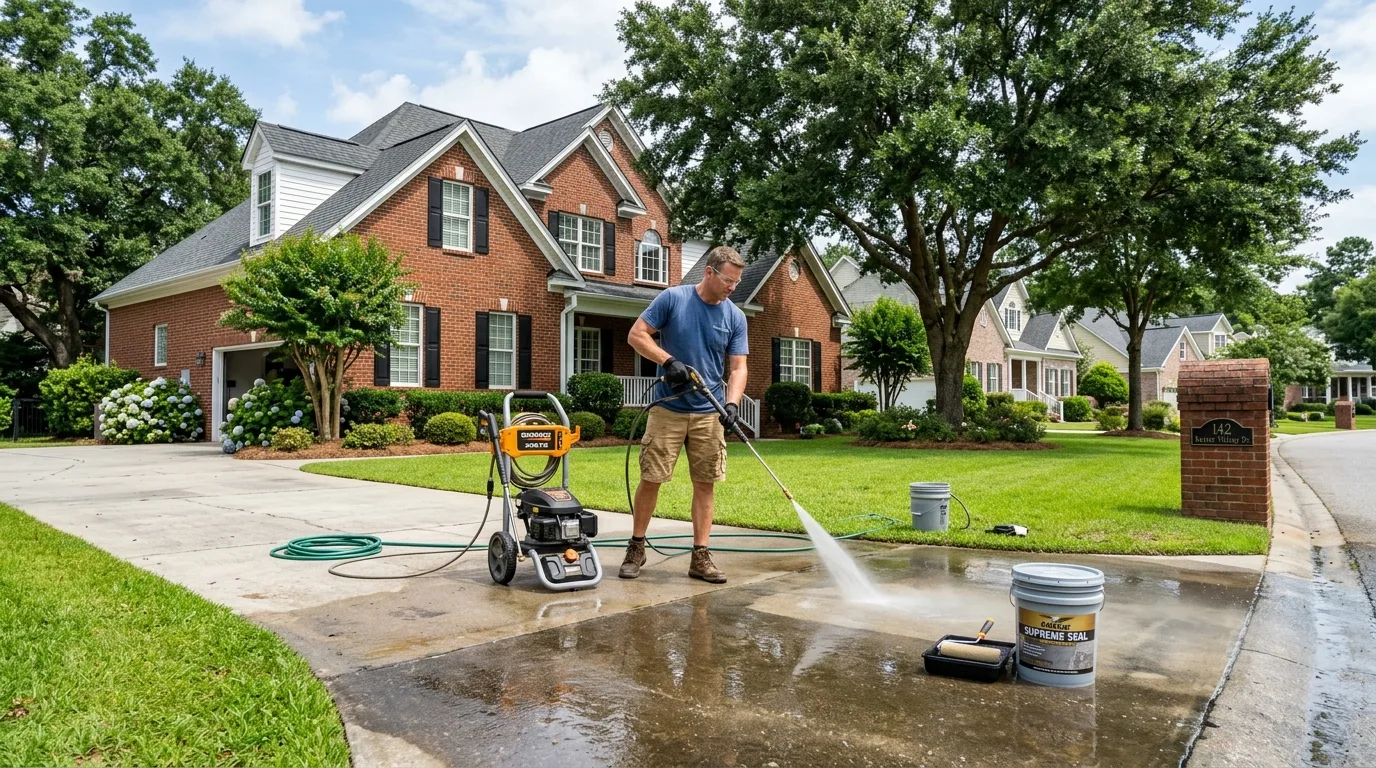
Most Spartanburg homeowners who replace a concrete driveway after just 15 years look back and realize they did very little to maintain it in the years between installation and failure. A concrete driveway in South Carolina that receives basic maintenance — sealing, crack filling, and cleaning on the right schedule — can last 30–50 years. One that doesn’t gets attacked by SC’s freeze-thaw cycling, UV radiation, and clay soil moisture cycling in ways that accelerate damage exponentially. This guide covers the specific maintenance steps that extend concrete driveway life in South Carolina’s climate.
Is Your Spartanburg Driveway Due for Maintenance?
We seal, repair, and resurface concrete driveways throughout Spartanburg County. Call (888) 376-0955.
The Most Important Maintenance Step: Sealing
Sealing is the single highest-return maintenance action you can take on a concrete driveway in South Carolina. A quality penetrating sealer bonds with the concrete’s pore structure and creates a hydrophobic barrier that prevents water from infiltrating the slab. Without sealing, water enters through microscopic pores and macro cracks, initiates freeze-thaw cycling in winter, and saturates the clay soil beneath the slab — accelerating the very soil movement that causes cracking and settlement.
When to first seal a new driveway in Spartanburg: Wait 28 days after installation for the concrete to reach full cure before applying the initial sealer. Applying sealer too early can trap bleed water in the slab and cause surface scaling.
Resealing schedule for South Carolina: Apply a fresh coat of penetrating sealer every 3–5 years. The 3-year end of that range applies to driveways in high-sun, high-traffic conditions; 5 years is appropriate for partially shaded, lower-traffic driveways. A simple water test tells you when resealing is needed: if water no longer beads on the surface and instead absorbs into the concrete, the sealer has worn through.
Sealer type for Spartanburg’s climate: Penetrating sealers (silane-siloxane formulations) outperform surface-film coatings for South Carolina’s climate. They bond within the concrete pore structure rather than sitting on top of the surface, providing freeze-thaw and UV protection without the peeling and flaking that film-forming sealers develop as they age. For stamped concrete, a UV-resistant topical sealer is typically used in addition.
Prompt Crack Repair
In Spartanburg County’s clay soil environment, a crack in your concrete driveway is not just cosmetic — it’s an entry point for water that will infiltrate the subbase, promote freeze-thaw cycling in winter, and accelerate the soil movement that caused or will worsen the crack. Prompt crack repair is the second most important maintenance practice after sealing.
Hairline cracks (under 1/8 inch wide) that are stable — not growing over time — can be addressed with a quality concrete crack filler during a resealing cycle. Many penetrating sealers will partially fill hairline cracks during normal application.
Wider cracks (1/4 inch and above) require dedicated crack filler — polyurethane caulk for flexible repairs, or epoxy for structural repairs. For cracks showing differential movement (one side higher than the other), professional assessment is needed before repair.
Recurring cracks — cracks that reappear within a year or two after filling — indicate that the underlying cause (soil movement, drainage failure) hasn’t been addressed. Filling recurring cracks without addressing the root cause is a temporary measure. See when concrete driveway repair is no longer enough for guidance on when replacement becomes more economical.
Need Concrete Crack Repair in Spartanburg?
We assess and repair concrete cracks throughout Spartanburg County — free estimates at (888) 376-0955.
Seasonal Maintenance for South Carolina’s Climate
Spring (March–May): After Spartanburg’s winter, inspect the entire driveway surface for new cracks, scaling, or areas of heave. Winter is the most damaging season for unsealed concrete — the December through February freeze-thaw cycling can open new cracks or widen existing ones. Spring is the ideal time to fill cracks and apply a fresh sealer coat if the driveway is overdue.
Summer (June–August): Avoid deicing salts — though less common in Spartanburg than in northern markets, sodium chloride and calcium chloride accelerate concrete surface deterioration and increase porosity. In summer, the main threat is oil and fuel leaks from parked vehicles; clean these with a degreaser promptly, as petroleum products soften concrete binders over time. Avoid parking very heavy loads (RVs, construction equipment) on concrete in extreme heat — Spartanburg’s 90°F+ summer days soften concrete slightly, reducing its resistance to surface indentation under point loads.
Fall (September–November): Fall is the second-best maintenance window after spring. If you missed a spring crack-filling or resealing cycle, fall is a good alternative — temperatures in the 55–80°F range support good sealer cure before winter. Clean the driveway of leaf and organic debris that holds moisture against the surface through winter.
Winter (December–February): Avoid mechanical snow removal tools with sharp metal edges that can chip concrete surfaces. If ice forms, use fine sand for traction rather than deicing chemicals. If deicing chemicals are needed, calcium magnesium acetate (CMA) or potassium acetate are less damaging than sodium chloride. Never use rock salt (sodium chloride) on concrete less than one year old or on unsealed concrete.
Cleaning Concrete Driveways in Spartanburg
Regular cleaning extends concrete sealer life and prevents staining that becomes harder to remove over time. Standard driveway cleaning can be done with a garden hose and concrete cleaner, or with a pressure washer set to 1,200–2,000 PSI. Higher pressure can damage concrete surfaces — particularly on older driveways with surface scaling.
Specific stain types require specific treatments:
- Oil and grease: Cat litter, dish detergent, or commercial degreaser applied and worked in before rinsing
- Rust stains: Oxalic acid-based cleaners
- Tire marks: Citrus-based degreasers applied with a stiff brush
- Algae and mildew: Diluted bleach solution (1 part bleach to 10 parts water) rinsed thoroughly
Avoid acid-based cleaners on new concrete less than six months old — they can etch the surface.
Frequently Asked Questions
How often should I seal my concrete driveway in South Carolina?
Seal your Spartanburg concrete driveway every 3–5 years with a penetrating silane-siloxane sealer. The water bead test is the easiest guide: if water beads on the surface, the sealer is working. If water absorbs into the concrete surface, resealing is overdue. In South Carolina’s climate — 48+ inches of annual rain and freeze-thaw cycles in winter — sealing consistently on this schedule significantly extends concrete lifespan.
Can I seal my own concrete driveway in Spartanburg?
Yes — penetrating sealers are available at hardware stores and can be applied by homeowners with a pump sprayer or roller. The key steps are: clean the surface thoroughly and allow it to dry completely (24–48 hours after rain), confirm no rain is forecast for 24 hours after application, and apply in two thin coats rather than one heavy coat. For driveways with significant cracking or surface deterioration, professional assessment before sealing is recommended.
What is the biggest threat to concrete driveways in South Carolina?
In Spartanburg specifically, the combination of expansive clay soil movement and freeze-thaw cycling is the biggest threat. Clay soil movement causes cracking and settlement; freeze-thaw cycling infiltrates those cracks and widens them. Sealing eliminates the water infiltration that drives the freeze-thaw cycle, making it the most effective single maintenance practice for Spartanburg concrete driveways.
Spartanburg Concrete Maintenance — We Handle It All
Sealing, crack repair, and resurfacing for Spartanburg driveways and patios. Call (888) 376-0955.
Related: