
5 Signs Your Concrete Driveway Needs Replacing in Spartanburg, SC
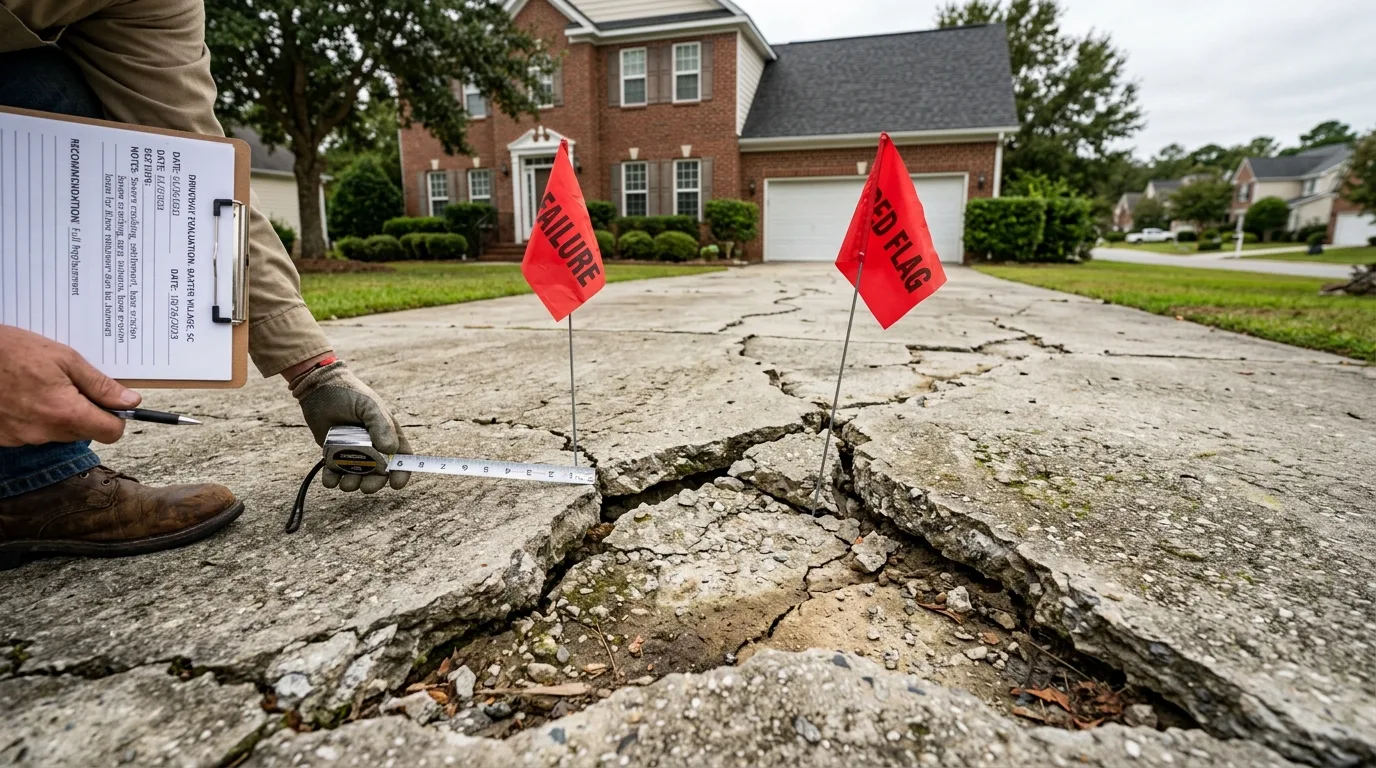
Spartanburg homeowners often try to stretch another year or two out of a failing driveway with patch repairs — and sometimes that’s the right call. But there are situations where continued patching costs more over time than simply replacing the slab. The difficulty is knowing which situation you’re in. In this post, we identify five specific signs that your Spartanburg concrete driveway has crossed the threshold where replacement is the more economical choice, and explain why each condition reaches that point in Spartanburg County’s clay soil and climate context.
Not Sure If Your Spartanburg Driveway Needs Repair or Replacement?
We assess every driveway honestly — no upselling. Call (888) 376-0955 for a free evaluation.
Why the Repair vs. Replace Decision Matters in Spartanburg
The instinct to repair rather than replace is understandable — patch repairs cost less upfront. But when the underlying conditions driving the damage aren’t corrected, patches fail within 1–3 years in Spartanburg County’s clay soil environment. Every patching cycle costs money without addressing the root problem, and the cumulative cost of repeated repairs on a structurally failed driveway often exceeds replacement cost within 5–7 years.
Spartanburg’s expansive clay soils create a specific pattern: slabs poured without a compacted gravel subbase continue to experience seasonal soil movement that breaks up any surface repair. Replacing the driveway is the opportunity to install the proper base preparation that prevents the cycle from repeating. For the right cases, it’s not just necessary — it’s the most economical long-term decision.
Sign 1: Widespread Cracking Across More Than One-Third of the Surface
A concrete driveway with one or two discrete cracks can often be repaired with crack injection and surface patching. A driveway with cracks running across 30% or more of the surface area — a network of cracks rather than isolated ones — has typically reached the end of its patchable life. At that coverage level, the subbase has failed and the slab has become a collection of independent sections rather than a structural unit.
In Spartanburg, this pattern most often appears in driveways 20+ years old that were installed without proper base preparation on the county’s clay soils. The Wadsworth Hills and South Converse neighborhoods have a notable number of homes with driveways from the 1990s and early 2000s that show this widespread cracking pattern — installed to the standards of the time, which didn’t account for modern understanding of clay soil movement.
If patching a crack that reappears within 1–2 years is already your experience with the driveway, that’s a strong indicator that the subbase has failed and replacement is the appropriate next step. See our concrete driveway service page for what a properly prepared new installation looks like.
Sign 2: Significant Differential Settlement — Sections at Different Heights
When two adjacent sections of a driveway have settled at different elevations, the slab has broken apart structurally — not just cracked at the surface. Differential settlement, where one section drops 3/4 inch or more below the adjacent one, creates a raised edge that’s a trip hazard and indicates that different parts of the subbase have failed at different rates.
Mudjacking (slab lifting) can temporarily address differential settlement by pumping material beneath the lower section to re-level it. However, in Spartanburg County’s clay environment, the underlying cause — inadequate base preparation and clay soil movement — continues after lifting. Many homeowners who mudJack a settling driveway find that the same section re-settles within 3–5 years, requiring another mudjacking cycle or full replacement. When mudjacking has already been performed once and settlement has recurred, replacement is typically the more economical path.
Is Your Spartanburg Driveway Settling Unevenly?
We assess whether repair or replacement makes more sense for your specific situation. Call (888) 376-0955.
Sign 3: Active Drainage Failure — Water Flowing Toward the House
A properly graded concrete driveway slopes away from the house — minimum 1/4 inch per foot — so that rainfall runs toward the street or designated drainage areas. When settlement, heaving, or grading failure causes water to pool on the driveway or flow toward the foundation, the drainage function of the driveway has failed.
This is more than an aesthetic problem. Water flowing toward a Spartanburg foundation accelerates the soil saturation cycle that drives the shrink-swell clay movement causing the settlement — a self-reinforcing problem. It also increases foundation moisture risk. A driveway that consistently drains toward the house requires attention not just to the driveway itself, but to what the misdirected water is doing to the foundation and soil beneath.
Surface patching cannot correct a drainage failure caused by settlement — the slab geometry itself is wrong. Full replacement with a correctly graded pour is the appropriate correction. If you’re also seeing foundation symptoms — see our guide on concrete foundation repair for Spartanburg homeowners.
Sign 4: Severe Surface Spalling Across the Majority of the Driveway
Surface spalling — where the concrete surface layer flakes, pits, or breaks away in chunks exposing the aggregate beneath — is the cumulative result of freeze-thaw cycling and UV degradation on unsealed or poorly sealed concrete. In Spartanburg, driveways that were never sealed or haven’t been sealed in 10+ years often show severe spalling after the December–February freeze period passes.
Partial spalling (one or two sections) can be patched with polymer-modified mortar and resurfacing overlay. Severe spalling across 50%+ of the surface is typically not patchable in a way that provides lasting results. The bonding between a resurfacing overlay and a severely degraded base is poor, and the overlay will begin delaminating within a few years in Spartanburg’s climate. Full replacement is more economical than attempting to resurface a slab in this condition.
Sign 5: The Slab Is More Than 30–40 Years Old With Multiple Repair Attempts
Concrete driveways properly installed in Spartanburg last 30–50 years. Driveways installed 30–40 years ago — particularly those from the 1980s and early 1990s — were often installed without the subbase standards now understood to be necessary for Spartanburg County’s clay conditions. If an older driveway has already been patched multiple times without lasting results, it’s approaching the end of its useful life regardless of the specific current condition.
The economic logic: at 35 years old, a Spartanburg driveway has perhaps 5–15 years of remaining service life under the best circumstances. Spending $1,000–$2,000 on another round of patching to extract another 2–3 years from it — when replacement provides a fresh 30–50 year lifespan for $4,000–$8,000 — often doesn’t make sense from a total cost perspective. The return on replacement investment is higher than the return on continued repair for most homeowners planning to stay in the home for more than a few years.
When Repair Is Still the Right Call
Not every driveway showing problems needs full replacement. Repair is appropriate when:
- Damage is isolated to 1–2 discrete sections that aren’t showing signs of ongoing settlement
- The driveway is less than 15 years old and the base preparation was done correctly
- The cracks are cosmetic rather than structural
- The homeowner is planning to sell within 2–3 years and needs a cost-effective solution
Our concrete repair service page covers when repair is the right approach in more detail.
Frequently Asked Questions
How much does it cost to replace a concrete driveway in Spartanburg?
Concrete driveway replacement (demo and pourback) in Spartanburg typically runs $5,000–$7,000 for projects under 500 sq ft and $7,000–$10,000 for 500–1,000 sq ft, based on local pricing. These ranges include removal of the old slab, hauling, base preparation, concrete, and finishing. The proper base preparation included in replacement is what makes the new driveway last significantly longer than the one being replaced.
Can I repair concrete cracks myself in Spartanburg?
Consumer crack fillers and patching products are appropriate for very minor, stable hairline cracks. For cracks that are growing, show differential movement, or have recurred after previous repairs, professional assessment is needed. DIY patching on cracks caused by active soil movement simply delays necessary intervention and adds cost without solving the underlying problem.
How do I know if my Spartanburg driveway needs mudjacking or replacement?
Mudjacking makes sense when: settlement is minor (under 1 inch), the driveway is less than 20 years old, the concrete itself is in good condition with limited cracking, and this is the first time significant settlement has occurred. Replacement makes more sense when: the driveway has been mudjacked before and re-settled, the concrete is severely cracked or spalled, or the driveway is more than 25 years old. We assess each situation individually and give our honest recommendation.
Get a Free Driveway Assessment in Spartanburg
Repair or replace? We tell you what we actually found and why — no obligation. Call (888) 376-0955.
Related: