
Why Spartanburg's Clay Soil Matters for Your Concrete Project
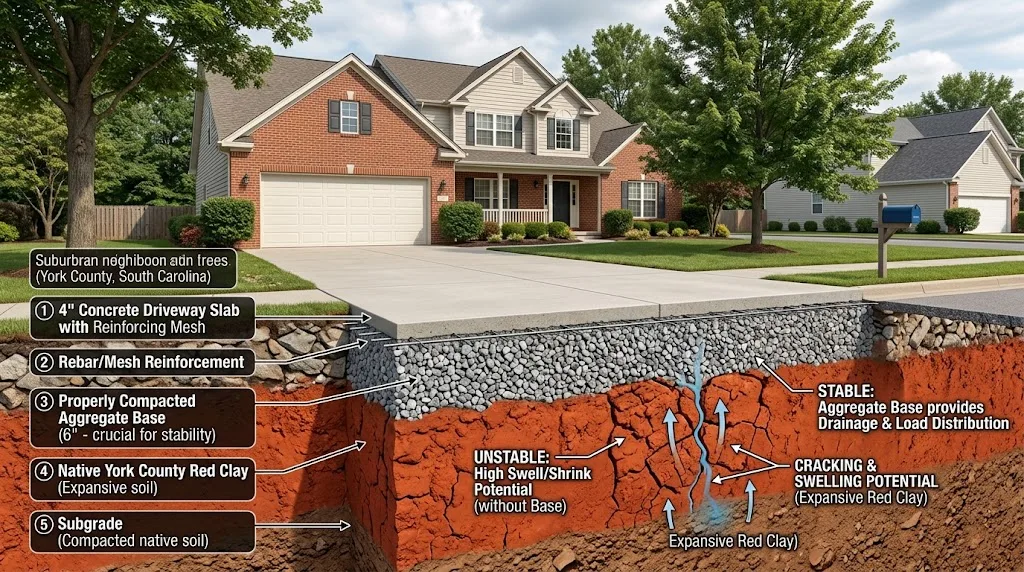
Every spring, Spartanburg homeowners discover new cracks in driveways and patios that looked fine the previous fall. The cause isn’t poor quality concrete — it’s the ground beneath it. Spartanburg County sits in South Carolina’s Piedmont region, where the dominant soil types are among the most expansive in the Southeast. If you’re planning any concrete work in Spartanburg — or wondering why existing concrete is failing — understanding the local soil is the starting point. In this post, we cover what makes Spartanburg’s clay soils different, how they damage concrete, and what proper installation does to prevent it.
Building on Spartanburg County Clay?
We engineer every concrete project for local soil conditions. Call (888) 376-0955 for a free estimate.
What Type of Soil Is Under Spartanburg?
Spartanburg sits in the Piedmont physiographic province, a belt of metamorphic and igneous rock that runs from Virginia through Georgia. The soils that develop from this weathered rock are dominated by two series: Cecil soils and Pacolet soils — both clay-rich, reddish-orange clay loams that you’ve seen in excavations throughout the area.
Both series are classified as having high shrink-swell potential. The specific clay mineral responsible is smectite, which has a layered crystal structure that expands as water molecules enter between the layers and contracts as they leave. This physical property — swelling when wet, shrinking when dry — is the root cause of most concrete problems in Spartanburg County.
The “active zone” where seasonal moisture fluctuation occurs extends several feet deep in most of Spartanburg County. Below that depth, the moisture content is more stable. The closer a concrete slab sits to the active zone without a drainage buffer, the more movement it will experience over the course of a year.
How Shrink-Swell Soil Damages Concrete
The damage mechanism is straightforward. When Spartanburg receives rainfall — the city averages 48.41 inches annually, spread fairly evenly throughout the year — the clay beneath an unprotected concrete slab absorbs water and swells upward. This upward pressure (called heave) can crack concrete slabs and create differential movement between adjacent sections.
When drought conditions arrive, particularly during summer months when evapotranspiration is high and rainfall is absorbed quickly by vegetation, the clay contracts. The soil literally pulls away from the underside of the concrete slab, creating voids. Once a void forms, that section of slab has lost its foundation. The next significant rainfall — or vehicle load — causes the unsupported section to crack and drop.
This cycle repeats every year. The cumulative effect over 5–10 years on a slab poured without proper preparation is progressive cracking, uneven settlement, and eventually structural failure requiring replacement rather than repair. Properties throughout the Converse Heights and Grain District neighborhoods built before modern subbase standards show this pattern on older concrete installations.
Freeze-thaw cycling compounds the problem. When water from rainfall or ground moisture infiltrates an existing crack and freezes during Spartanburg’s winter temperature drops to January’s average low of 29°F, it expands and widens the crack. The combined effect of clay-driven cracking and freeze-thaw crack widening is what causes concrete to deteriorate significantly faster in Spartanburg than in sandier soil regions.
Concerned About Your Existing Concrete in Spartanburg?
We assess soil-related damage and recommend the right repair approach. Free estimates at (888) 376-0955.
What Proper Base Preparation Does
The solution to Spartanburg’s expansive clay is simple in concept: separate the concrete from the clay with a drainage layer that doesn’t expand and contract. In practice, this means:
Excavation to stable subsoil. We excavate deep enough — typically 8–10 inches below finished grade — to remove the most active portion of the clay layer and reach more stable subsoil. Any organic material, root systems, or fill soil is removed.
Compacted aggregate base. We install 4–6 inches of compacted #57 crushed stone over the stable subsoil. This angular stone doesn’t compress when wet, doesn’t shrink when dry, and allows water to drain laterally rather than pooling against the slab underside. Mechanical compaction is critical — loose aggregate provides far less stability than mechanically compacted stone.
Reinforcement. Wire mesh or rebar holds the concrete together if minor cracking does occur, preventing sections from separating and settling at different levels. On Spartanburg County’s clay soils, reinforcement is not optional — it’s standard for all structural concrete.
Expansion joints. Scored at regular intervals, these joints control where seasonal cracking occurs — directing it to intentional locations rather than random surface fractures. Properly placed joints allow the slab to flex slightly as it heats and cools without developing uncontrolled cracks.
What This Means for Concrete Repair
When we’re called to evaluate failing concrete in Spartanburg — whether it’s a concrete driveway, patio, or foundation slab — the first question is always whether the root cause (soil-driven movement) has been addressed or just the surface symptom. A crack fill or resurfacing overlay on a slab that’s still in direct contact with moving clay will fail again within a few years as the soil continues its seasonal movement.
Effective concrete repair in Spartanburg for soil-related damage requires addressing the drainage or base preparation issue alongside the surface repair. In some cases, that means lifting and re-bedding a section. In others, it means improving perimeter drainage to reduce the saturation cycle driving the soil movement. We explain our reasoning for every repair recommendation in writing before any work begins.
Frequently Asked Questions
How do I know if my concrete damage is soil-related in Spartanburg?
The most telling sign is differential movement — when one side of a crack is higher than the other, indicating that one section of slab has heaved or settled relative to its neighbor. Cracks that open up in spring and partially close in summer are also characteristic of clay-driven heave. Cracks that appear after a dry period and show sections that have sunk below grade indicate void formation from clay shrinkage.
Does landscaping affect concrete in Spartanburg’s clay soils?
Yes — significantly. Tree root systems extract moisture from clay soil in a wide radius around the tree, causing localized soil shrinkage and settlement directly beneath and adjacent to the slab. Drought years amplify this effect. Concrete within 15–20 feet of large trees in Spartanburg County is at higher risk for settlement cracking. Addressing root barriers or tree proximity is sometimes part of a comprehensive concrete repair plan.
Is all of Spartanburg County’s soil the same?
No — soil conditions vary across Spartanburg County. Properties on hilltops or slopes tend to have shallower clay over rock, while lower-lying areas and former floodplains may have deeper clay deposits or fill material. The South Converse and Hampton Heights neighborhoods near downtown Spartanburg sit on classic Piedmont clay. Properties in newer subdivisions in Boiling Springs and Duncan may have been regraded with fill during development, which can behave differently. A site visit allows us to assess the specific soil conditions for your project.
Get a Concrete Estimate Built for Spartanburg's Soils
Spartanburg Concrete Pros engineers every project for local conditions. Call (888) 376-0955.
Related: